
Table of Contents
Introduction: Why the 4 Types of Artificial Intelligence matter
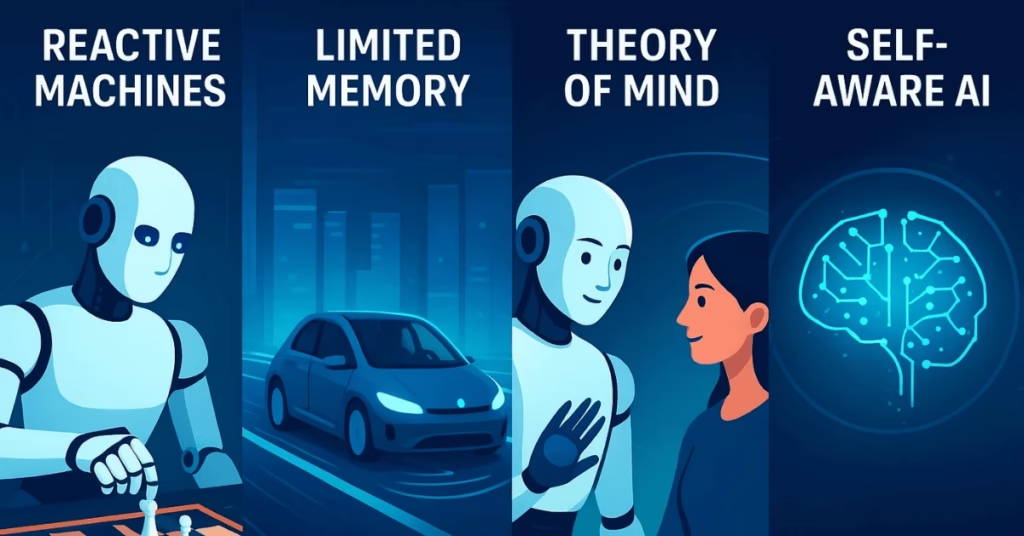
When you think about Artificial Intelligence (AI), you might envision humanoid robots or scenes straight out of a sci-fi movie. But the reality is that AI exists in various levels of intelligence and capability. By understanding the 4 types of Artificial Intelligence, we can better appreciate what’s possible today and what the future may hold. Many reputable sources categorize AI not just as “narrow, general, or super intelligent,” but also by how it functions—how it behaves, learns, remembers, and interacts. IBM
In this post, we’ll explore each of these four types—what they mean, real-world examples, their advantages and limitations—and wrap up with some FAQs and a call to action.
1. Reactive Machines – The First Type of Artificial Intelligence
What Are Reactive Machines?
Reactive machines are the most basic type of artificial intelligence among the four categories. They simply respond to input based on programmed rules and don’t have any memory of past experiences. Bernard Marr
Because they don’t retain memories or learn, they can’t adapt over time beyond their initial programming.
Example of Reactive Machines
A classic example is IBM’s Deep Blue, the chess-playing computer that famously beat world champion Garry Kasparov in 1997. It analyzed chess moves and reacted accordingly, but it didn’t “learn” from previous games beyond what it was programmed to do. IBM
Other examples include systems that respond to stimuli in real-time without any memory building.
How They Work
A reactive machine operates by:
- Observing the current input (like the board position or sensor read-out)
- Applying predefined rules or models
- Producing an output (like a move or decision)
Since there’s no memory of past states, even if the same situation comes up again, the reaction will always be the same.
Benefits & Limitations
Benefits:
- Very predictable behaviour
- Efficient for specific repetitive tasks
- Lower complexity (no training/learning)
Limitations: - Cannot learn or improve from experience
- Lacks adaptability to new or unseen scenarios
- Limited scope of application
Use Cases
- Game-playing AI (for fixed rules)
- Basic automation tasks
- Some sensor-reactive systems
Key takeaway: In the realm of the four types of AI, reactive machines are the foundational stage—simple and effective, but also quite limited.

2. Limited Memory – The Second Type of Artificial Intelligence
What Is Limited Memory AI?
This is the next step in the evolution of Artificial Intelligence, following the four main types. Unlike reactive machines, limited memory AI systems can tap into past data (albeit for a limited time) to guide their decisions. They learn from experience, but within certain boundaries. IBM
Many of today’s AI applications fit into this category.
Example of Limited Memory AI
- Take self-driving cars, for instance: they monitor other vehicles, pedestrians, and road signs, using both past observations and real-time data to make driving choices. IBM+1
- Then there are virtual assistants and chatbots, which rely on previous interactions or training data to respond more effectively.
- Recommendation engines also often fall under the limited memory umbrella.
How They Work
Limited memory AI leverages stored data (whether historical or recent) along with algorithms (like machine learning or deep learning) to:
- Observe current situation
- Reference stored/past data/experiences
- Generate decisions or predictions based on both
It gets better over time, as long as the data and models are kept up to date.
Benefits & Limitations
Benefits:
- Adaptive: learns from experience
- Offers better predictions and decisions compared to purely reactive systems
- Powers many modern AI applications
Limitations: - Memory is still limited: it can’t store every experience indefinitely
- Needs data, training, and infrastructure
- Doesn’t yet grasp human emotions or deeper contexts
Use Cases
- Autonomous vehicles
- Chatbots/virtual assistants
- Fraud detection, recommendation systems
- Various machine learning-powered systems
Key takeaway: Within the framework of the four types of Artificial Intelligence, limited memory marks the stage where AI becomes genuinely useful for a wide range of business and consumer applications today.

3. Theory of Mind – The Third Type of Artificial Intelligence
What Is Theory of Mind AI?
his represents the third stage in the four types of Artificial Intelligence. Theory of Mind AI goes beyond just processing input and recognizing patterns; it aims to understand human emotions, intentions, and beliefs, adjusting its behavior accordingly. IBM
In simpler terms, it would be able to recognize that humans (and possibly other entities) have their own mental states and respond in a fitting manner.
Current Status & Example (Emerging)
As of now, Theory of Mind AI is still a work in progress. It’s mostly in the experimental phase. bmc.com
That said, there are some prototypes out there (like robots that can detect emotions or change their facial expressions) that give us a glimpse of this potential. For instance, the Kismet robot developed at MIT was created to recognize human emotions. Bernard Marr
How It Works (In Theory)
For a Theory of Mind AI system to function, it would need:
- Emotional/context recognition (voice tone, facial expressions)
- Intent inference (predicting what a human might do)
- Adaptive behaviour (modify responses based on inferred state)
This requires advanced AI, social behavior modeling, and even a touch of psychology.
Benefits & Limitations
Benefits:
- Human-machine interactions become more intuitive
- Useful in therapy, education, customer service, and as companion robots
Limitations: - Extremely complex to develop
- Ethical and privacy concerns (like reading emotions)
- Still in the research phase: not widely used commercially
Use Cases (Future)
- Companion robots for elderly or children
- Emotion-aware virtual assistants
- Smart tutors that adapt to student feelings
- Robots collaborating with humans in team environments
Key takeaway: Among the four types of Artificial Intelligence, Theory of Mind represents a significant advancement — machines that not only act but also understand human mental states. While we’re not quite there yet, the journey is just beginning.

4. Self-Aware AI – The Fourth Type of Artificial Intelligence
What Is Self-Aware AI?
The last stage in the four types of Artificial Intelligence is Self-Aware AI. These systems would have consciousness, an understanding of themselves, their internal states, and perhaps even their own goals. IBM
Currently, this remains hypothetical.
Conceptual Example & What It Implies
We often encounter fictional representations of self-aware AI, like HAL 9000 from 2001: A Space Odyssey or J.A.R.V.I.S from Marvel stories. While these characters are not real, they help us grasp the idea of machines capable of self-reflection.
- Recognize their own existence
- Develop internal goals
- Potentially experience emotions or drives
- Function independently in new situations
Benefits, Risks & Limitations
Benefits:
- Could surpass human intelligence (artificial general intelligence)
- Might tackle complex, unresolved problems
Risks: - Ethical dilemmas: rights, autonomy of AI
- Control issues: if AI has its own goals, alignment becomes critical
- Privacy/security: more autonomy means more responsibility
Limitations: - We currently lack the technology to create truly self-aware machines
- Still in theoretical research and philosophical Discussion
Use Cases (Speculative)
- Autonomous systems that evolve themselves
- AI in space exploration with independent decision-making
- Advanced scientific research assistants with self-motivation
Key takeaway: Among the four types of Artificial Intelligence, self-aware AI represents the ultimate frontier—a vision of machines that believe they are alive. But for now, it remains a concept rooted in theory and research.

Summary Table: The 4 Types of Artificial Intelligence
| Type | Memory / Learning | Human-emotion understanding | Usage Situation |
|---|---|---|---|
| Reactive Machines | No memory, no learning | None Fixed tasks | Fixed tasks, rule-based |
| Limited Memory AI | AI Learns from past data | Minimal | Many current AI systems |
| Theory of Mind AI | Learns + infers human states | Yes (future) | Emerging human-AI interaction |
| Self-Aware AI | Full self-awareness, autonomous | Yes (and self) | Theoretical future systems |
The Future of the 4 Types of Artificial Intelligence
Grasping the four types of Artificial Intelligence gives us a clearer picture of how far AI has advanced — and where it might be headed. Right now, we’re mostly in the realm of limited memory AI, especially in the business world. The shift towards theory of mind and self-aware AI brings a mix of excitement and caution.
Companies like IBM, Google Cloud, and various educational platforms highlight that while the first two types are actively in use, the latter two are still in the research phase.
Looking ahead, we can expect even greater capabilities, but with that comes significant ethical challenges: transparency, bias, autonomy, and the need for human oversight.
FAQs: Your Questions Answered
Q1: What are the 4 types of Artificial Intelligence?
The four types are Reactive Machines, Limited Memory AI, Theory of Mind AI, and Self-Aware AI. Bernard Marr
Q2: Which type of AI is used by systems like virtual assistants or chatbots?
These typically fall into the Limited Memory AI category since they can remember past interactions and learn over time, but they still lack a true understanding of human emotions or self-awareness.
Q3: Is Self-Aware AI real today?
Not yet — it’s still just a theoretical idea. We don’t have machines that are genuinely self-conscious or capable of forming their own goals. bmc.com
Q4: Why is it useful to know about the 4 types of AI?
Understanding these types helps you:
- Grasp what current AI can and can’t achieve
- Set realistic expectations for AI in both business and personal contexts
- Identify where research is headed and the potential risks involved
Q5: Can AI jump directly from limited memory to self-aware?
In theory, maybe, but research indicates there are significant steps (like developing a theory of mind) that need to be taken first. This transition would require major advancements in cognition, autonomy, and ethics.
Call to Action (CTA)
Ready to get ahead of the curve in AI and see how it can impact your business, learning or creative work?
👉 Download our free “AI Capability Checklist” to evaluate your readiness for the 4 types of Artificial Intelligence.
👉 Subscribe to our newsletter for weekly insights on AI, machine learning, and innovation.
👉 Contact us today to explore how your organisation can leverage limited memory AI — and prepare for the future as the other types evolve.
- More Readings .
- AI Interior Design: Transform Your Home Decor with Smart Tech.
- Latest GPT Model 2026 | New OpenAI Features & What It Means.
- How to Make Money Online in the USA (2025 Guide).
- Agentic AI for Small Business: How to Boost Growth in 2026.
About the Author
👤 Muhammad Ibrahim – Founder of Mindliftly
Muhammad Ibrahim is a technology writer and wellness advocate who loves to dig deeper into the potential of AI to enhance mental well-being, productivity, and personal growth. An experienced researcher with years of tracking emerging technologies, he brings scientific perspective and actionable strategies to guide readers to understand AI-fueled tools for daily calm and clarity.
Through Mindliftly, Ibrahim offers guides, comparisons, and action plans that link AI innovation to people’s well-being. His vision is straightforward: to enable humans to live more conscious, stress-free lives through responsible and effective use of AI.
📩 Connect with Muhammad:
- Website: Mindliftly.com


