
Table of Contents
Introduction
“ChatGPT Job Killer 2026” — it might sound a bit dramatic, but this phrase really highlights a significant change happening in the job market. With tools like ChatGPT and other generative AI advancing rapidly, entire job categories that once felt secure are now facing new challenges.
Recent statistics indicate that by 2026:
- AI-driven agents could take over thousands of jobs. IT Brief UK
- More and more tech job listings are asking for AI skills — about 50% of tech positions already require some knowledge of AI. dice.com
- Tasks that were traditionally done by people are being reimagined, automated, or enhanced. McKinsey & Company
In this blog, ChatGPT Job Killer 2026: 5 Jobs Lost & 3 New AI Roles we’ll take a closer look at:
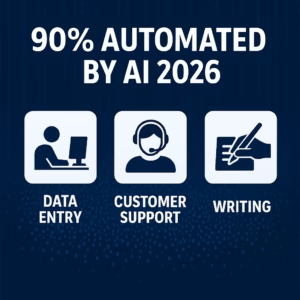
- Five job roles that are at a high risk of being 90% automated by 2026.
- Three new career paths you can start preparing for right now.
- Tips on how to future-proof yourself (or your team).
- Common questions about this transition.
- A conclusion with actionable steps.
Let’s jump in!
Part 1: Five Roles at Risk of Being 90% Automated by 2026. ChatGPT Job Killer 2026
Let’s dive into five job roles that, given the current trends, are likely to be mostly automated in the near future. When we say “90% automated,” we’re not suggesting that humans will vanish entirely; rather, it means that most of the daily tasks could be taken over by AI or machines.
1. Customer Service / Call-Centre Agents
A prime example of this shift is the rise of chatbots and AI agents, which are increasingly managing first-line support. This allows human agents to focus on more complex issues. A recent article highlighted that companies anticipate that by 2026, over half of the work done by HR professionals, software engineers, and customer service agents will be handled by AI. IT Brief UK
Additionally, roles like customer service representatives, telemarketers, and call-centre support are also on the chopping block. Winssolutions
Why this role is at risk
- These positions involve a high volume of predictable, repetitive tasks (think password resets and basic troubleshooting).
- Businesses are highly cost-sensitive, leading to a push for outsourcing and automation.
- Advancements in natural language understanding, chatbots, and voice agents are making this possible.
What humans will still do
- They’ll focus on complex problem-solving, emotional or high-stakes conversations, and nuanced interactions.
- Building relationships, upselling, and strategic cross-selling will still require a human touch.
- Humans will also be needed for AI supervision, training, and managing escalations.
2. Data Entry / Routine Administrative Clerks
This is a classic case of automation risk: tasks that are routine, repetitive, and rule-based are perfect for AI and bots. The “48 jobs AI will replace by 2026–30” list includes positions like data entry clerks, document drafters, legal clerks, and registrar office clerks. Winssolutions
Why vulnerable
- These roles have minimal variability in tasks and are highly standardized.
- They’re also cheap to automate on a large scale.
- AI has matured in areas like optical character recognition, document processing, and natural language tasks.
Implications
- These roles may shrink or evolve into supervisory or auditing functions.
- Employees in these positions should consider upsk
3. Basic Banking / Teller & Loan Processing
The finance industry is already experiencing this change. This includes roles like bank tellers, loan officers, and underwriters. Winssolutions
Additionally, a comprehensive analysis has shown that AI and automation could potentially transform or take over 50-60% of jobs worldwide. mycareernet.in
Why this role is at risk
- A lot of the tasks are based on rules: handling deposits, processing standard loans, managing checks, and ensuring routine compliance.
- Fintech and digital banking are striving for less human interaction.
- AI can assess risk, process forms, and verify compliance much quicker than people can.
What still requires a human touch
- Complex credit decisions, relationship banking, advisory roles, and interactions with high-net-worth clients.
- Human trust, regulatory judgments, and the interpretation of nuanced cases are still very much in the human realm.
4. Entry-Level Content / Marketing / Copywriter Roles
With tools like ChatGPT and DALL·E, generative AI is becoming a go-to for whipping up first drafts of content, marketing copy, and social media posts. A recent article highlighted that many entry-level white-collar jobs might be at risk. While the focus was mainly on the UK and US, this trend is being felt worldwide. Business Insider
Why are these roles vulnerable?
- There’s a high volume of content that lacks differentiation.
- We see predictable patterns in things like blog posts, social media captions, and product descriptions.
- Generative AI is advancing quickly and is becoming more cost-effective.
What still needs a human touch?
- Strategy, brand voice, in-depth creative work, original research, and the art of human storytelling.
- Plus, there’s the important job of supervising and refining the content that AI generates.
5. Process Operators & Routine Manufacturing / Logistics Roles
From the bustling factory floors to the organized warehouses and delivery routes, automation and AI are making significant strides. The list of “jobs at risk” includes assembly line workers, warehouse and logistics personnel, and even truck drivers in the long run. Winssolutions
In the UK, research predicts that by 2026, there will be around 100,000 AI agents in the workforce, with HR and software roles being particularly affected. IT Brief UK
Why are these roles vulnerable?
- Physical automation, like robots, is working hand in hand with AI to take over many human tasks.
- In logistics and delivery, the focus is on speed, cost-effectiveness, and scalability.
- We’re seeing the rise of self-driving technologies, warehouse robots, and AI systems that coordinate operations.
What still requires a human touch?
- Maintenance, handling exceptions, managing high-fault cases, driving innovation, and providing oversight.
- Strategic planning, supply chain design, and the human oversight of complex logistics are still very much in our hands.
Part 2: Three Emerging Careers for 2026 and Beyond. ChatGPT Job Killer 2026
Let’s dive into the bright side: while some jobs may fade away, exciting new opportunities are on the horizon. Here are three careers you can start gearing up for right now.
A. AI Prompt Engineer / AI Workflow Designer
As generative AI becomes a part of our everyday lives, the demand for professionals who can create effective prompts, design workflows, and manage AI-human interactions is set to rise. A report from Coursera highlights that positions like AI Engineer, Data Engineer, and NLP Engineer are increasingly sought after. More and more, companies will be on the lookout for experts who can effectively “ask” AI the right questions, create seamless workflows, and integrate AI agents into their business operations.
Key skills
- A solid grasp of large language models and generative AI (think ChatGPT, GPT 4/5).
- Proficiency in workflow design, process thinking, and integration (APIs, automation).
- Skills in human-AI interface design, prompt logic, and output evaluation.
- Domain knowledge in areas like marketing, supply chain, or HR to leverage AI effectively.
B. Data Curator & Augmentation Specialist
With an explosion of data and AI systems craving high-quality input, the need for specialists who can clean, label, augment, and curate data is skyrocketing. The World Economic Forum’s Future of Jobs Report 2025 highlights the evolving nature of work and the growing importance of data skills. Data curators serve as the vital link between raw data and AI systems, ensuring that the data is contextualized, free from bias, and of high quality.
Key skills
- Expertise in data cleaning, annotation, metadata, and domain knowledge.
- Ethical oversight, bias auditing, and ensuring fairness and transparency in data.
- Collaboration with AI engineers and domain specialists.
- Adaptability: as new data sources emerge (like IoT, edge-AI, and multi-modal), this role will continue to evolve.
C. Human-AI Interaction Specialist / AI Ethics & Governance Advisor
As AI becomes more integrated into organizations, the need for roles focused on governance, ethics, and human-AI collaboration will expand. Supervising AI agents, managing human-AI transitions, and designing human-centered AI systems will be crucial. An article on “5 AI-Era Skills Mistakes” emphasizes the importance of addressing these challenges head-on. Bernard Marr
Key skills
- A solid grasp of AI ethics, fairness, regulations, and the boundaries between humans and machines.
- Crafting hybrid workflows that blend human and AI efforts: knowing when to hand things off to a person and when to let automation take the reins.
- Effective communication and change management: weaving AI into the fabric of the organization, providing training, and redefining roles.
- Keeping a close eye on AI systems through monitoring, auditing, and implementing supervisory controls.
Part 3: What You Can Do Now — Action Plan for 2026. ChatGPT Job Killer 2026
If you’re feeling anxious about being in one of those “at risk” roles, or if you’re eager to get ready for the new opportunities on the horizon — here’s a solid action plan to guide you.
1. Upskill in AI Literacy
You don’t have to become a full-fledged AI engineer, but it’s essential to grasp:
- What generative AI can do and what it can’t.
- How to craft effective prompts, manage workflows, and collaborate with AI.
- The basics of data, understanding model bias, and how AI systems make decisions.
2. Focus on “Human-Plus” Skills
As automation takes over, jobs that rely solely on mechanical or routine tasks are at risk. Here are the skills that will keep you relevant:
- Critical thinking and complex problem-solving.
- Emotional intelligence, persuasion, and managing people.
- Creativity and the ability to apply tools in innovative ways.
3. Embrace Hybrid Roles
Instead of resisting AI, help your organization integrate it. Learn how to create workflows where humans and AI work together — this will make you an invaluable asset.
4. Build Domain Expertise + AI Application
Even in “emerging roles,” having deep knowledge in your field (like marketing, supply chain, or HR) combined with an understanding of AI workflows can be incredibly valuable. If you know your domain inside and out and can leverage AI tools effectively, you’ll stand out.
5. Monitor Industry Trends & Pivot Early
Keep an eye on the tasks your job entails. If you find yourself doing high-volume, low-variation tasks — that’s a warning sign. Think about repositioning yourself sooner rather than later.
6. Internal Link Suggestion
If you have relevant content on your site, like “How to Upskill for the AI Era” or “Top AI Tools for Marketers 2026,” linking to those from this blog will benefit both your readers and your SEO.

Frequently Asked Questions (FAQ). ChatGPT Job Killer 2026
Q1. Will ChatGPT really “kill” my job by 2026?
That sounds a bit dramatic, doesn’t it? A more realistic view is that many jobs will evolve — some tasks will be automated while new ones will emerge. Instead of just “doing repetitive work,” you might find yourself “overseeing AI doing it.” For instance, one trend analysis suggests that AI could take over as much as 70% of daily work tasks by 2026. Medium
Q2. If my job is at risk, what should I do?
Don’t wait! Start building your AI knowledge now. Identify the repetitive parts of your job and think about how you can transition into a more supervisory or strategic position. Consider upskilling for one of the “new” careers mentioned earlier.
Q3. Which industries will be hit hardest?
Industries that rely heavily on high-volume, standardized tasks, like banking, customer service, data entry, and manufacturing/logistics, are likely to feel the impact the most. However, no job is completely safe unless it involves human judgment, creativity, unpredictability, or relationship-building. The WEF report highlights that changes will affect various industries. reports.weforum.org Q4. Do these changes only apply to developed countries?
Not at all. Automation is a global phenomenon. In fact, developing countries might face a “double vulnerability” due to a high concentration of low-skill, high-automation-risk jobs combined with lower levels of AI readiness. arXiv
Q5. Will there be new jobs to replace the old ones?
Absolutely! The three emerging careers mentioned earlier are just a start. Many experts believe AI will create roles we haven’t even thought of yet. The key is to stay prepared and adaptable.
Conclusion. ChatGPT Job Killer 2026
The phrase “ChatGPT Job Killer 2026” really hits home with a mix of anxiety and opportunity. Sure, many jobs are likely to undergo major changes or even be automated by 2026. But on the flip side, new careers and chances will definitely pop up. The secret lies in being prepared, adaptable, and strategically enhancing your skills.
If you find yourself in a job that feels a bit too routine, it’s time to start making a change. And if you’re already in a cutting-edge field, focus on becoming that invaluable human-plus-AI asset that companies will be eager to have.
Call to Action (CTA): ChatGPT Job Killer 2026
If you enjoyed this blog, don’t forget to subscribe to our upcoming “Future of Work AI Series” and grab our free PDF “10 AI-Prompt Templates for Marketers & Admins” (link below). ⬇️ [Download Now]. www.mindliftly.com
We’d love to hear from you in the comments: Which of the 5 risky roles caught you off guard the most — and how do you plan to adapt?
Let’s get ready for the future together.
- More Readings .
- 7 Free AI Tools to Make Money Online.
- 4 Types of Artificial Intelligence Explained (With Real-Life Examples).
- Latest GPT Model 2026 | New OpenAI Features & What It Means
About the Author
👤 Muhammad Ibrahim – Founder of Mindliftly
Muhammad Ibrahim is a technology writer and wellness advocate who loves to dig deeper into the potential of AI to enhance mental well-being, productivity, and personal growth. An experienced researcher with years of tracking emerging technologies, he brings scientific perspective and actionable strategies to guide readers to understand AI-fueled tools for daily calm and clarity.
Through Mindliftly, Ibrahim offers guides, comparisons, and action plans that link AI innovation to people’s well-being. His vision is straightforward: to enable humans to live more conscious, stress-free lives through responsible and effective use of AI.
📩 Connect with Muhammad:
- Website: Mindliftly.com


