
Table of Contents
Introduction: The Next Leap in AI Evolution
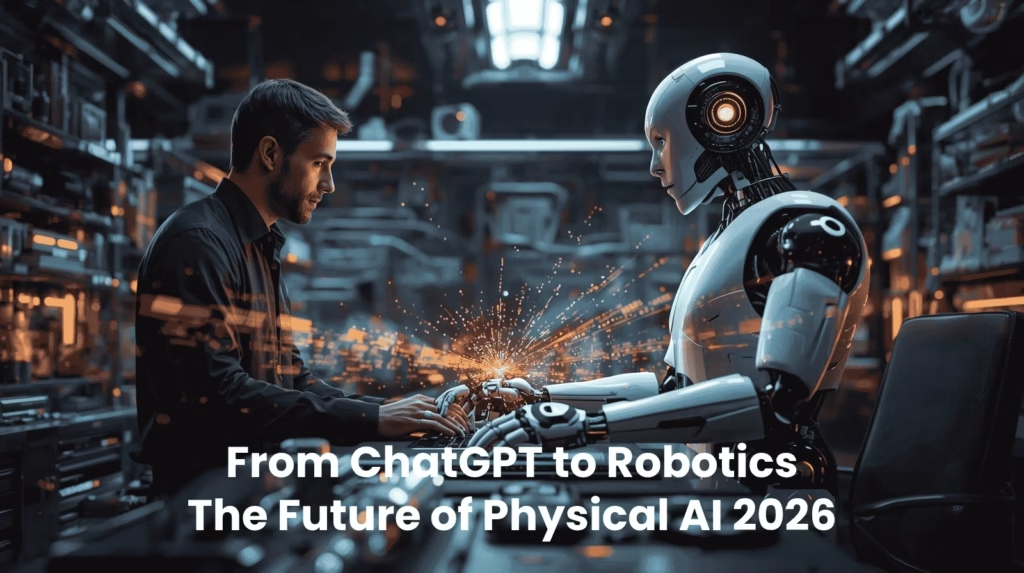
n 2023, ChatGPT changed the game for how we interact with machines. Fast forward to 2026, and we’re witnessing a shift from ChatGPT to Robotics, a groundbreaking leap where artificial intelligence steps out of the digital realm and into the physical world. This exciting transformation, often referred to as Physical AI, connects language-driven intelligence with real-world actions. We’re seeing everything from self-learning robots in factories to AI doctors performing surgeries, showcasing the practical side of machine intelligence.
The phrase From ChatGPT to Robotics perfectly encapsulates this revolution: it’s no longer just about chatting with AI; it’s about collaborating with AI in our everyday lives.
1. Understanding Physical AI
Physical AI is all about blending cognitive intelligence—like what you find in ChatGPT’s language models—with robotic systems that can tackle complex physical tasks. These AI-powered robots do more than just respond to questions; they can actually perceive their surroundings, make decisions, and take action in real time.
According to a 2025 report by McKinsey & Company, suggests that industries embracing Physical AI could boost their productivity by as much as 40% by 2030.
(External Reference: McKinsey on AI and Productivity)
This exciting development isn’t about replacing humans; it’s about empowering them to work smarter, faster, and safer.
2. Why 2026 Is the Turning Point
In 2026, we’re looking at a pivotal moment where cloud-based AI and edge robotics come together in an exciting way. Thanks to the availability of budget-friendly sensors, cutting-edge neural chips, and innovative generative models like GPT-5, robots will be able to grasp context, recognize emotions, and respond to voice commands more effectively than ever.
Here are some key elements driving this transformation:
- Edge AI chips: These will enable robots to make quicker decisions on the fly.
- Multimodal AI models: This technology will blend text, vision, and voice into a seamless experience.
- Autonomous learning: Imagine robots that can learn and adapt continuously based on real-world feedback.
(Internal Reference: Mindliftly: Latest GPT Model 2026 – What It Means)
3. From ChatGPT to Robotics in Manufacturing
Factories are undergoing a remarkable transformation as AI-powered machines step into more adaptable roles. Unlike the traditional robots that are just programmed for repetitive tasks, Physical AI robots can learn from language models similar to ChatGPT, allowing them to adjust their operations on the fly.
For example:
- imagine a robot receiving a voice command like “assemble this part differently”—it can instantly tweak its programming to comply.
- AI-driven inspection drones are also making waves, capable of spotting micro-defects with the help of computer vision.
Companies like Siemens and Boston Dynamics are already in the testing phase with Physical AI assistants that work alongside human employees, ensuring safety and efficiency in the workplace.
4. From ChatGPT to Robotics in Healthcare
The healthcare industry is rapidly adopting Physical AI like never before. Surgeons are now utilizing robotic arms that are guided by algorithms similar to those used in GPT for highly precise surgeries. The combination of ChatGPT’s conversational skills and the finesse of robotics is setting a new benchmark for collaboration between humans and AI.
Here are a couple of examples:
- AI nurses that keep an eye on patients and engage with them in a caring manner.
- Robotic surgery systems that can make tiny, crucial decisions during operations.
As reported by Harvard Health Publishing, AI-assisted robotic surgeries have been shown to cut down error rates by 35% and speed up recovery times by 25%.
(External Reference: Harvard Health on AI in Surgery)

5. From ChatGPT to Robotics in Logistics and Retail
In 2026, logistics companies are set to combine chat-based AI with robotics to run entire supply chains on their own. Picture a warehouse where AI anticipates demand while robots efficiently pick, pack, and ship products in real time.
Retail giants like Amazon and Alibaba are creating AI-powered warehouse ecosystems where systems fueled by ChatGPT manage fleets of robots through natural language commands.
(Internal Reference: Mindliftly: 7 Free AI Tools to Make Money Online 2025–2026)
6. From ChatGPT to Robotics in Education and Training
Education has evolved far beyond just digital classrooms. By 2026, we can expect physical AI teaching assistants that will engage with students through both spoken words and hands-on demonstrations. Imagine a “ChatGPT-style tutor” teamed up with a humanoid robot, capable of illustrating intricate physics experiments or language gestures right before your eyes.
This interactive learning experience, driven by AI, not only enhances engagement but also makes education more accessible for learners with different abilities.
7. How It Will Redefine Jobs
One big worry people have about AI is the potential for job loss. However, Physical AI is actually creating new hybrid roles instead of just taking over all human jobs. For example:
- AI Robotics Supervisors are responsible for keeping an eye on how machines are performing.
- Prompt Engineers for Robots craft the conversational commands that AI bots use to interact.
- Physical AI Trainers work on perfecting how robots engage in various industries.
According to the World Economic Forum’s 2026 Report, we can expect nearly 97 million new tech-driven jobs to pop up thanks to the integration of AI and robotics.
(External Reference: WEF Future of Jobs Report)
8. Benefits for Businesses
Key Advantages:
- Efficiency: Automation in real-time helps minimize downtime.
- Communication: Control through natural language, thanks to ChatGPT-like systems.
- Adaptability: Robots can learn from their mistakes on their own.
- Cost-effectiveness: Lower operational Cost
Industries that embrace Physical AI are gaining a competitive edge in speed, accuracy, and decision-making—essential for thriving in the economy of 2026.
9. Challenges Ahead
While the potential is enormous, there are still hurdles to overcome:
- Ethical concerns: Who takes the blame when a robot messes up?
- Data privacy: Physical AI gathers sensitive information from the real world.
- Regulation gap: Laws are struggling to keep pace with AI advancements.
Organizations like the OECD AI Policy Observatory are working on global guidelines to ensure the responsible use of Physical AI.
(External Reference: OECD AI Policy)
10. The Future of Physical AI
Looking ahead to 2026 and beyond, we can expect the boundaries between AI software and robotics to completely dissolve. Imagine self-learning robots that can grasp natural language, recognize emotions, and even navigate social situations.
Here are a few predictions:
- AI Companions providing support in elderly care homes.
- Autonomous farming robots employing ChatGPT-like reasoning for smarter crop planning.
- AI Police Drones AI police drones utilizing ethical decision-making models to help minimize human bias.
(Internal Reference: Mindliftly: ChatGPT Job Killer 2026: 5 Jobs Lost & 3 New AI Roles
FAQs:
Q1. What is the difference between ChatGPT and Robotics?
ChatGPT is a conversational AI model that focuses on text and language, while robotics takes AI into the physical realm, enabling machines to act on that intelligence.
Q2. How will Physical AI impact small businesses?
Small businesses can leverage cost-effective AI robots for customer service, production, and logistics, which can help cut costs and enhance efficiency.
Q3. Are robots replacing humans completely?
Not at all—robots are here to work alongside humans, taking care of repetitive or hazardous tasks so that people can concentrate on creativity and decision-making.
Q4. What skills are needed for future jobs in Physical AI?
By 2026, skills like AI prompt design, robotics engineering, machine learning, and ethical AI governance will be in high demand.
Q5. When will Physical AI become mainstream?
Experts anticipate that by late 2026, we’ll see widespread adoption of Physical AI in sectors like healthcare, logistics, and manufacturing.
Conclusion:
The journey from ChatGPT to Robotics isn’t just about technology; it’s a true transformation. It marks a significant leap for humanity, moving from simple conversations to genuine collaboration with machines. By 2026, companies that embrace Physical AI early on will be at the forefront of a new industrial revolution, blending creativity with computational power.
The future isn’t about choosing between man or machine — it’s about the partnership of man + machine, working together in perfect harmony.
Call to Action (CTA)
Want to stay ahead of AI trends shaping 2026?
Visit Mindliftly.com for deep insights, future job trends, and AI-powered growth strategies tailored for your business.
About the Author
👤 Muhammad Ibrahim – Founder of Mindliftly
Muhammad Ibrahim is a technology writer and wellness advocate who loves to dig deeper into the potential of AI to enhance mental well-being, productivity, and personal growth. An experienced researcher with years of tracking emerging technologies, he brings scientific perspective and actionable strategies to guide readers to understand AI-fueled tools for daily calm and clarity.
Through Mindliftly, Ibrahim offers guides, comparisons, and action plans that link AI innovation to people’s well-being. His vision is straightforward: to enable humans to live more conscious, stress-free lives through responsible and effective use of AI.
📩 Connect with Muhammad:
- Website: Mindliftly.com


